In this particular class, the entire grade is tied to a single exam. I know that is not the case for all courses, but it was the tradition and is still followed in many cases (that's the way it was for many classes in Slovenia in 1995). When I asked if she had considered short quizzes at the start of each class she commented that she had so many students it was too hard to manage. She passed a roll sheet around (not quite sure why if all the grade is attached to the exam) and it probably had about 100 names. She also teaches another class.
Thursday, February 28, 2008
In this particular class, the entire grade is tied to a single exam. I know that is not the case for all courses, but it was the tradition and is still followed in many cases (that's the way it was for many classes in Slovenia in 1995). When I asked if she had considered short quizzes at the start of each class she commented that she had so many students it was too hard to manage. She passed a roll sheet around (not quite sure why if all the grade is attached to the exam) and it probably had about 100 names. She also teaches another class.
Tuesday, February 26, 2008
four are students at Rider U. They assumed they would eat us out of house and home. They left stuffed and there was still food left. Kim always makes an extra effort to cater to each specific group's tastes and food allergies. These guys commented on how they missed their Buffalo chicken. Kim made 3 pizzas: a barbecue, a spicy Buffalo chicken and her renowned garlic chicken (her brother's recipe). Jason actually ate so much he felt poorly but was still happy.
I wanted to tell you some other stuff:
- Our little section of Italy is very excited about the Oscars. The statue for Art Direction on Sweeney Todd went to Dante Ferretti and Francesca Lo Schiavo - LOCALS! He's in Boston working on a film with Scorcese, who he worked with when he won his last Oscar for Aviator in 2005. The local paper had an interview with him (in Italian, obviously).
- Last night, the 58th annual Sanremo Festival began, a six-night extravaganza. It's a competition, but it's much more. The contestants are only part of the evening - there are also guest performances by Italians and International artists (last night, Lenny Kravitz performed). The festival is live on TV each night. There's so much I can say about this festival. The main host, Pippo Baudo (71 years old), is hosting for his 13th time. The other three are first-timers. Only one of the two women hosts appeared last night, Andrea Osvalt. Andrea is a 28-year-old Hungarian immigrant. Last night she got emotional explaining what a thrill it was for her to make it to this point. Her immigration papers still list her occupation as "domestic" because to get entry as an entertainer is not easy to do. She said she was an example of what an immigrant could achieve.
- Lots of other TV and radio shows talk about what's going on at Sanremo.
- The TV listings this week said that you can even place bets on the winners, and listed the odds for each contestant. This contestant was the odds-on favorite. Not sure if any of these videos will play for you. Here in Italy we can't watch US network videos because of licensing issues. Not sure whether you'll be able to see these.
- Fifty years ago at Sanremo, a performer named Domenico Modugno introduced the song "Nel Blu Dipinto di Blu," known in the US as "Volare." They're making lots of allusions to it and him. This video on YouTube is not his Sanremo performance, but Eurosong (a pan-Euro music festival) from the same year, 1958. A current "legend" Gianni Morandi opened the festival with his version.
- You may know there's going to be an election in Italy April 13 and 14. All performers were required to sign a form stating that they would NOT make political statements. The festival adamantly wants to be apolitical. Piero (the other male host) cracked several jokes about that last night.
- The other media phenomenon to mention is a young man (47) named Rosario Fiorello. He's a multi-talented guy who has recorded more than a dozen CDs, does impressions, tells jokes, etc. In 2002 he teamed up with Marco Baldini and started hosting a radio show, Viva Radio Due. People thought he was nuts because radio is a dying medium. His show's numbers have pushed the radio ratings through the roof - people are listening in droves (live and to the delayed rebroadcast), and the show is available as a podcast, getting even more listeners. I guess I want to believe that great talent on a personality-driven program is a real growth possibility for radio, not just in Italy.
Saturday, February 23, 2008
There has been a lot of controversy in higher education circles about study abroad lately. One issue has been "kickbacks" to schools from for-profit programs. That's not an issue with Ball State or AHA. The other controversy has been the "quantity versus quality" debate. Schools tout how many students they send overseas but not the quality of the experience. I need to do everything I can to get the word out about the outstanding quality of this AHA - Macerata program. Allow me an example. In summer 2005 I taught for 5 weeks with another consortium. We spent 25 days in Florence. The students then did not see and do all the Macerata students did in just three days. In addition, I picked up a brochure in the hotel for guided walking tours. One promoted a 3 hour tour of the "secrets" of Florence and included a visit to Michelangelo's David. The price was $63. A two hour tour of the Uffizi Gallery was priced the same. Our students did both. Forget the discussion about expense: the amount of teaching Fliberto did over three days was phenomenal. Indulge me while I go into detail about the schedule:
Wed., 5:30 a.m. - board the charter bus for Florence. After the initial excitement, most students slept.
We stopped around 8 a.m. for a coffee break. For the final hour as we approached Florence, Filiberto intermittently spoke on the mic about what we saw.
9:30: Visit San Mineato al Monte, an ancient church that sits above the main city.
10:45: The bus drove us down to Hotel Unicorno, our home for the next couple of days.
11:15 - The students had free time. Kim and I took a few of them to the San Lorenzo market area, where we had had amazing sandwiches from a place in 2005. Unfortunately, Mr. Perini himself (whose picture appears in the front of the Williams-Sonoma Florence book) was on vacation, but we still got our wonderful sandwiches.
13:00 - One major improvement over 2002 is the rental of guide mic/headset system that allows all of us to hear Filiberto. We had them for the afternoon and it made it SO much better. Our tour of the main town began with the Baptistry. To show the exterior, doors and interior requires that I link to several sites. We left there and went just a few yards to visit the Cathedral itself,
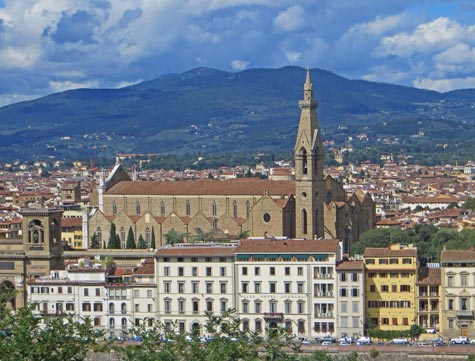
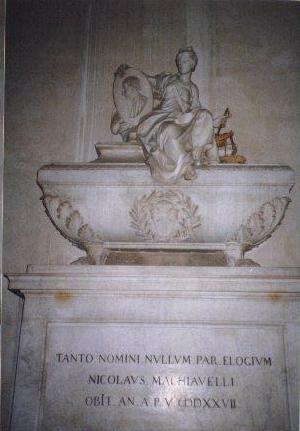
At 15:15, we walked to the Chiesa di Santa Croce (Holy Cross Church) which is a museum more than a church. In it are the tombs of many famous Italians including Michelangelo, Galileo and Machiavelli. The three sad figures you see at the foot of Mike's tomb are the arts (painting, sculpture and architecture) depressed at his passing. I took a picture inside the refectory.
I couldn't believe the coincidence. Our dinner (at 20:30) was at Tira Barala, the place where we ate for 25 straight nights in 2005. Nothing wrong with the place - we just got tired of it. Anyway, this meal was better than the economic menu they served us under the other program. Dinner ended around 10:30, putting an end to our 17 hour day. Of course, some of the students still went out afterward.
Thursday, Filiberto had wake up calls for all at 7:30 a.m. Breakfast was 8:15 - 9, an American-style breakfast complete with scrambled eggs, breakfast cereal and coffee that was a cross between Italian and American. The students were very excited.
At 9 we walked back to the Cathedral to walk up to the top of the dome. I'm including a picture
At 10:15 it was off to the church of San Lorenzo (St. Laurence). I don't know how Wikipedia got interior shots - pictures are not allowed. At 11:15 it was off to Palazzo Medici-Riccardi, Piazza dell'Annunziata and the Ospedale degli Innocenti. At noon they got a short break. At 12:15, we were on to the Galleria dell'Accademia to see lots of things, but Michelangelo's David is the reason for the museum. No pictures are allowed in the museum, although hundreds of people each day (thousands?) take them. A Google image search will yield about 145K hits. I really have mixed feelings about this. The ban is ridiculous: are they afraid a photo will hurt the marble? No, clearly they want to sell books, prints, postcards, etc. But, it's the rule. If I want a picture of Dave, I can just go online and get one without surreptitiously taking one. We broke for lunch at 13:15. This would be a good time to mention we had 3 guests visiting from the Midwest Consortium: one from Concordia University Ann Arbor and two from Saginaw Valley State University. Those three, Filiberto, Kim and I went to a place for lunch Filiberto knew. The owner wasn't there, so a waitress called and Filiberto talked with him. A few minutes later we were getting a full meal at a reduced price. At 15:00 it was time to tour Santa Maria Novella. We finished at 16:45 when the students got a long break before dinner. At 20:00 we went to dinner. Another footnote: the hotel was going to make the arrangements for the second night's dinner. When Filiberto asked at the hotel on Wednesday, the desk staff acted as if they didn't know anything about what he was talking about. He walked over to the place and they were oblivious. He left, went to another person he knew, and arranged for Thursday's dinner, then went back and told the other restaurant we didn't need them to make room for us. It may not seem like much, but arranging a discount meal for a group of 30 usually requires quite a bit of arranging. He lost about an hour of time on Wednesday but everything turned out great. No one else could direct this program like he does.
Friday's wake up calls came at 7 a.m. because we had to have breakfast and our bags packed and in the lobby by 9:05. We walked around a little over an hour examining the architecture of significant buildings like Palazzo Strozzi, Piazza della Republica and Piazza della Signoria (there's a link above). At 10:35 we had our appointment to visit the Uffizi Gallery. I'm including this Wikipedia Link, but I can't believe they don't include Leonardo's Annunciation in the list of famous paintings. This tour gives some idea of how big the collection is. Click on a room or two (room 15 has the Annunciation I mentioned). Again, no pictures allowed.
The formal program ended at 13:15. Students had almost 3 hours before we got our bags and hopped a public bus for Macerata. Because so many students elected to stay behind and head elsewhere for the weekend, the charter was not economical. It wasn't bad - we just had to change buses once in Perugia.
Once again, another example of Filiberto's skills. He asked students on Monday to commit to coming home with us or not so he could reserve our seats. Well, some people changed their minds and we ended up with more wanting to come home than we reserved. As a mater of fact, there was really no room on the second bus for all of us. No matter - Filiberto talked with a friend, and all of us had seats. Filiberto had to sit in the "jump seat" for part of the trip, but he made it work for everyone.
We had a fabulous time. Now, let me tell you a few gripes. This is all said after telling you how wonderful everything was.
- A few of the students left the Uffizi early because they were catching trains to other points. One group left just as we were entering Room 15 (with The Annunciation). The painting must be valued at tens of millions of dollars. They never saw it, or masterpieces by Vasari, El Greco or Flemish masters.
- We almost left a bag at the hotel. One of the students believed she had arranged for another student to take it back while she traveled elsewhere, but that student was taking TWO other students' bags back. If it hadn't been for Kim we would have left it. This morning (Saturday) at 8:15, she buzzed at our door wanting to pick it up. I'm thinking I will be sure to call her at 8:15 on a Saturday morning if she thinks that time is OK to call on people.
- Our excursions are definitely long and involve lots of walking, but some of our students act as if they're dying. Filiberto is 52 (he probably didn't want me to say that) and he not only does all the walking, too, but he's the one doing all the teaching, talking almost the whole time and rarely sitting. Whenever we get to a location, some students look to find a place to sit as quickly as possible.
Monday, February 18, 2008
- Kim and I shop at several places. We tend to buy most of our produce on Wednesday from two guys in the market. Their prices are actually a little higher than another vendor, but the product is fresher, you choose your own (rather than the vendor sticking items in your bag for you) and they always add a little something to the bag - garlic, celery, carrots - just a little something as a thank you for your business. They also play by the rules - we always get a reciept, which is the law in Italy. The place that was cheaper didn't give us one.
- We also have one bakery that we tend to frequent more than others for bread. Grocery stores carry both bread and produce, and we do buy from them, but we more often get them (as do many Italians) at the places that specialize. We end up having to shop more often, but that's not just due to "specialized shops." When you have no car, and you have to carry whatever you buy, and you have an apartment-sized refrigerator, that's just the way it is.
- For other day in/day out groceries, we have a small grocery store inside the walls that we frequent. Tigre is a chain store with store brands, but ours is smaller than bigger stores in the suburbs. Still, they have a deli counter where we can get fresh meats/cheeses. Hours are 8-8 Mon - Sat, but they close 2-4 p.m. for midday.
- We make occasional bus trips to the mall, where Cityper is located. It is a large store, much like a Super Wal-Mart or Super Target, complete with all the clothes, household items etc. They are also open SOME Sundays. Busses run on an abbreviated schedule Sundays, so those trips have to be carefully planed.
- Inflation is a real problem here. Forget the fact that the exchange rate is killing us Americans - even Italians feel the pinch at the grocery store. There was a story in today's paper that 75 items will have price controls inposed for 6 months beginning March 1.
- In spite of this, there are still some items cheaper here than in the U.S. Most notably, wine prices make me smile. I have not paid more than $7.50 for a bottle of wine in the grocery store, and it's all been good. Kim's actually bought stuff for $1.50 (for a standard 750 ml bottle), but the lowest I've gone has been about $2.40. I tend to drink Montepulciano most. We do drink it in the US as well, but that has come to be what I've been drinking most here. Other less expensive items are local produce. We were getting artichokes for less than $1 each, and blood oranges from Sicily run less than $1/pound - Clementine tangerines even less. Believe it or not, dry pasta prices are just about the same as what we see in the U.S. (and a lot of the same brands). The good stuff runs about $1.60 for 500 grams (just over a pound) while the cheap stuff can go on sale for about 60 cents.
- Conversely, the more foreign something is, the more expensive it is likely to be. Peanut butter runs about $3.60 for a small (10-12 oz) and boxed tortilla shells are about $5 for 10.
- In spite of this (or maybe because it's so profitable) many stores have a lot more imported stuff than I recall. It used to be students wanting ketchup or Mexican salsa or breakfast cereals would have to jump on the bus for Cityper to find it. Now even our small stores inside the walls carry most of these.
- Standard operating procedure is to bring bags with you. Most grocery stores charge 5 cents per bag for the plastic ones they provide. Our Tigre has small flimsy bags available for you to use free, but if you want the larger more durable bags, the cashier sells those to you.
- Even small grocery stores note the country of origin of the fish and produce. I could be exaggerating but I think they're more attentive to the way products are raised. We bought some chicken/pork sausage in the "regular" meat counter (not some organic stuff) and the package mentioned the fact that the chickens were not caged and that the animals were humanely treated. The company makes a big deal about it. They are also VERY big on not using any form of growth hormone.
OK, again I'll finish with some local statistics:
- 7.4 percent of the Macerata population is foreign. The largest portion is Morrocan, followed by Indians and Albanians. There are 90 different ethnic origins represented.
- There are 1.2 percent more cars registered than a year ago. Registered drivers and traffic citations are also up.
Saturday, February 16, 2008
The reason Loreto is special is because it contains the remains of what is believed to be the home of the Virgin Mary at the moment of the Annunciation. I know, you might wonder how the remains came to be in Italy, since Mary was from the middle east. During The Crusades, the remains were "rescued" to keep them from being destroyed. Legend was "the angels" brought the house to Loreto. Documents show the Angelli
The other feature that makes the church unique from a structural perspective is that the central church is part church and part fortress. The church is near the Adriatic and the precious contents needed to be protected from pirates (they didn't want anyone taking what they had rescued).
In Loreto we had a coffee break, visited the Basilica (including, of course, the gift shop), and had some time to just "hang out," both in the piazza in front of the Basilica and behind it, where we could look out at the Adriatic.
We got back on the bus and headed just a short way north on the coast to the small town of Sirolo. In February it's a pretty sleepy town but come summer it will be a real hopping joint. There is a very nice photo gallery of Sirolo online
I really like this picture of Kim and Filiberto that I took in Sirolo, with Monte Conero (or at least a portion of it) in the background.
Believe it or not, even the Frasassi Caves don't allow pictures inside, so once again I took pictures of the exterior of the cave, and you'll have to look online to see the interior. The cave's own website doesn't have a comprehensive photo collection (they sell CDs and DVDs). I recommend you go to images.google.com and just enter "Frasassi" and you'll see individual pictures from all over the web. We walked to the cave entrance from the restaurant, all of us feeling rather stuffed, for our guided tour. Frasassi was discovered recently (1971), so the limestone formations haven't all been darkened by smoke from torches and candles, as is the case
Once again we boarded the bus to head to our final stop of the day, which was the Belisario winery. Due to Filiberto's connections we were able to have our own private tour of the winery, followed by our very own tasting. Belisaro has many wines, but it is located in the town of Metalica, and is best known for a special white wine known as Verdicchio. Verdicchio comes from two areas in the Marche: the hills around Jesi and the hills around Matelica. Most enophiles know the valley around Matelica to be the better of the two. The valley runs North/South, which makes the temperatures more extreme
There are dozens of websites that teach wine tasting techniques so I won't bother explaining here. Let it suffice to say that for some of the students, it was the first time they held a glass of wine for 10-15 minutes before they even took a sip. Our host (Luca, which will be my grandson's name) was very helpful and pleasant.
OK, more quick statistics from the newspaper:
- In 2007, 39 percent of the deaths in Macerata were due to probems of the circulatory system and 32 percent tumors.
- Married adults are 50 percent of the adult population, 39 percent single, 9 percent widowed, 2 percent divorced.
- University of Macerata has 13,659 students, up 850 from the previous year. Eighty-one percent of the sudent population lives outside the city center (where the university is located).
Thursday, February 14, 2008
The pale yellow stuff on the table is the cacao butter that is extracted. Some of this is used in the production of chocolate bars, chips, etc - everything except the powder. It's the butter that holds the product together - at least in the higher quality stuff. Lecithen, soy and other stuff gets introduced into cheaper chocolate. The butter can be used in foods or cosmetics, so there's a market for it - which is why cheap chocolate uses less. Of course it's high quality fat - no cholesterol, so it has even more of a market.
We were also taught that chocolate should be examined by all the senses. Look at it to be sure it is a uniform color. Obviously you smell it. When you break a bar, it should make a crisp snapping sound (and you should further see that the break is a clean line, not jagged). As for the feel, there's a feel in the mouth of course, but you should also be able to take a small piece and rub it between your fingers until it melts, and the butter ought to coat the fingers. As for taste we were taught that if you do a tasting involving several chocolates, you should NOT use water or wine in between chocolates. Water won't cleanse the palate, and wine is too strong a flavor so it will mask the chocolate. Instead some hard liquor should be used, followed by a small sip of water to remove the alcohol taste.
Alfredo Marangoni then poured out some chocolate with toasted rice to make what was a chunchy chocolate bar. He explained that
The paper published 2007 statistics that had been compiled locally. A couple of quick bits of info.
- Population has grown from 41,000 in 2001 to 43,000.
- There were 125 more deaths than births in 2007. Population growth can be accounted for by the 9 percent increase in immigrants.
- Seven percent of the population is 80 or older. Wow. I wonder how that compares to the rest of Italy, or to the US. I could do some research but won't.
More statistics next time.
Tuesday, February 12, 2008
- I've enabled comments on the blog. I hadn't done that before, but since looking at Kim's nephew Tim's blog, I decided to go ahead. Please feel free to post comments, but be gentle - I'm extremely sensitive :)
- Kim has a case of the winter crud. She's coughing, lots of drainage, etc. Several of the students here have had it, so we assume one of them probably caused it (tongue planted firmly in cheek).
- Last week Kim and I went to Ash Wednesday mass with a couple of BSU students, John and Jackie. The ashes were placed on our heads rather than on our foreheads. Filiberto later told me both systems are used here.
- Another church comment: in the US, where we say "forever and ever," Italians say "for centuries of centuries" (in Italian, of course). It's more poetic - is that why?
- A very interesting daily TV program is Blob, which is a 10-minute collection of video clips edited together. Most often they come from the previous day or two, but sometmes they throw in an older clip. The way they edit the clips can sometimes be commentary in itself.
- BUT, Blob doesn't hold a candle to Stricia la Noticia, which is a humorous news review. I'd compare it to Jon Stewart's The Daily Show but there are several differences. Many weeks, Stricia is the number one rated program. It's been on the air for 20 years with different hosts over time. You can't watch the show straight through online, but you can watch the pre-produced video segments.
- Students in the program have the option of participating in a Tandem program, where they are paired with an Italian student learning English. They're then supposed to meet and have conversations in both languages so each can learn. Kim is now participating. A middle school teacher is her Tandem partner. He happens to be one of the clients my 2002 students worked with when they made a video for the local hiking club.
- I heard on a game show recently that the median length of an Italian marriage was 14 years. I know what median means, but what I dn't know is whether that statistic is based only on marriages that have ended either through death or divorce (in which case the number seems frighteningly low) or includes all marriages, which I hope is the case. I also don't know how that compares to the US.
- Last week, one of the students commented that whenever people she meets find she's an American the first thing she is asked is whether she thinks Clinton or Obama will win the nomination. She was also astonished at how much they know about US politics.
- That leads to my next comment: Kim pointed out to the student that every bar or cafe here has at least a couple of daily papers, and that patrons from teenagers up flip through them. I don't know newspaper circulation statistics but I venture that a larger percentage of the Italian population peruses a newspaper daily than Americans.
- The Mafia may not be what it used to be in its heydey, but it's still alive and kicking. There was a major arrest last weekend in the New York-Palermo connection.
Sunday, February 10, 2008
Our chartered bus left just after 7 a.m. It's only about a 70 mile trip, but it takes almost 2 hours because you have to drive through the mountains to get there. I hope this link will show you. You may have to click the terrain button on the page - I'm not sure how it will load. I felt perfectly safe but it's no trip for someone who gets motion sick easily.
After a brief coffee break when we arrived (I included the picture of Filiberto's cappuccino for everyone to see, but mostly Nicole - those are chocolate flakes used to make the cup outline around the cream) , it was on to the Basilica of St. Francis.
Friday, February 08, 2008
After that, it needs to be spread out on the table.
Of course, I was too stupid to get a shot of the final product. No, I'm being too harsh. I was too hungry to get a shot of the final product, so this is the picture from the Wikipedia site. Trust me - ours looked quite like it.
I've mentioned that each week we have a different group of students over for dinner. Kim usually prepares something special. It's a real challenge, though, because she has t contend with the different students' food allergies, likes and dislikes. She also has to contend with things not being quite the same here. For example, here's last night's dinner bunch:
The week prior, we had Callie(Oregon), Audrey (Ball State), Andrew (Oregon) and Whitney (Ball State). We've made it to the end of the meal, where Kim had made Coke cake with real whipped cream (courtesy of the beater she bought). We've been having a lot of artichoke appetizer - it must be in season because it's reasonably priced and fresh.
The faculty member gets hired not the spouse, but these overseas programs should not overlook the value of a spouse who wants to be involved. Kim commits an awful lot of time (and expense) to preparing these meals. She makes an appetizer, first course, second course, salad and dessert. Others probably don't put in as much effort as she does, but they still spend time easing the transition for students in other ways.
Class today, then Assisi tomorrow.
Wednesday, February 06, 2008
Tuesdays are normally regular classroom days, but Filiberto rearranged the schedule to enable students to experience Carnevale in Ascoli Piceno, which is really quite impressive. We spent the morning touring the town as we usually do, learning about history, architecture and art. When we arrived just after 9 a.m., things in the town were still pretty quiet. Ascoli Piceno sits in the valley rather than on a mountaintop, and has a history that dates back to the Roman times - much older than Macerata.
We had lunch about 1:15. On day trips, meals are not included. Filiberto will make arrangements for a group lunch as an option for those who want to take advantage of it. We had a wonderful meal beginning with the famous Ascoli olives.
This was one of MANY troupes that addressed the issue of trash. As I explained in an earlier post, Campagna (the state where Naples is located) has a problem finding a place for all its trash. There were groups wearing trash bags, there were others carrying bags looking for places to "hide" their trash - lots of satire about the trash problem.
These two pictures are from the same troupe. Roughly translated, the sign says, "What labor crisis? If you need a job just go back to doing things the old way." The display had al kinds of medieval laborers at work (a commentary on employment issues).